The fastest path to a working lead qualification automation system is a 4–8 week pilot built around one process you already own. Run appointment scheduling or lead routing first. Neurohain’s pilot data shows 60–80% reductions in no-shows on appointment-driven workflows, and teams consistently report measurable gains in qualified-to-demo rates within 60–90 days when feedback loops are in place. One operational constraint to lock in before you start: any SMS outreach in your qualification flow must comply with TCPA consent requirements, which means written opt-in before the first automated message.
- Pick one process: appointment scheduling or lead routing, not both.
- Collect minimum data: 3–5 fields per lead record (name, company size, source, intent signal, and one behavioral trigger).
- Set a success metric before day one: qualified-to-demo rate, manual triage time saved, or no-show rate.
- Book a paid discovery session with a pilot vendor or internal lead to map the process before touching any tool.
Pro Tip: Lock your success metric in writing before the pilot starts. Teams that define “qualified” upfront cut scoring model rework by more than half.
Table of Contents
- What is lead qualification automation and why does AI change the math?
- What should SMEs automate first?
- How do you build a working pilot in 4–8 weeks?
- How do you measure whether it’s working?
- What are the biggest pitfalls and compliance risks?
- How does Neurohain’s pilot methodology work in practice?
- How do you choose a vendor or decide to build in-house?
- What does lead qualification automation actually cost?
- How do you get your team to actually use the new system?
- What’s coming next in lead qualification automation?
- Key Takeaways
- What do most guides on lead qualification skip?
- Neurohain’s pilot program gets you to a working system fast
- Further reading and useful sources
What is lead qualification automation and why does AI change the math?
Lead qualification automation is the practice of using software to evaluate, score, and route incoming leads without manual review for every record. The industry term for the AI-powered version is automated lead scoring, and it differs from traditional rule-based scoring in one critical way: AI scoring delivers dynamic assessment, continuously re-evaluating fit and intent as new signals arrive rather than locking leads into a static point total set months ago.
A rule-based system might say “anyone from a company with 50+ employees gets 20 points.” An AI model looks at that same firmographic signal alongside real-time behavioral data, like pages visited, form completions, and email engagement patterns, and produces a probability score that updates every time the lead takes an action. Missed qualified leads drop sharply because the model catches intent signals that rigid rules never would.
Data flows through four stages:
- Capture: form submissions, chat, phone, or CRM import
- Enrichment: firmographics, company size, funding signals, tech stack
- Scoring: weighted rules or an AI model producing a numeric score
- Routing: score thresholds trigger calendar booking, CRM assignment, or nurture sequences
Teams see measurable improvements across response times and conversion metrics within 60–90 days after deployment when AI blocks and feedback loops are implemented correctly.
What should SMEs automate first?
Start with the process that has the clearest data source and the lowest-risk fallback.
- Appointment scheduling and confirmations. Automated reminders and confirmations are the highest-ROI first automation for any appointment-driven business. The data already exists in your calendar or CRM, and a fallback is as simple as a manual call list.
- Lead routing by score and intent. Once a score exists, route hot leads directly to a booking link and warm leads to a nurture sequence. No more manual triage decisions.
- Automatic follow-up emails and SMS for warm leads. Responding within five minutes of a lead’s first action increases close probability significantly. Automation closes that window reliably.
- Lead enrichment for incomplete records. Missing company size or industry? A no-code pilot architecture using Sheets or Airtable with a GPT scoring prompt can fill gaps before routing.
- Simple nurture sequences for mid-score leads. Not every lead is ready to book. A three-email sequence triggered by score threshold keeps mid-funnel leads warm without rep involvement.
Before automating SMS, confirm written TCPA consent is captured at the lead source. Before automating email, verify CAN-SPAM compliance and unsubscribe handling.
Pro Tip: Start with the process that feeds a Google Sheet or Airtable today. If the data is already there, you can run a scoring pilot in days, not weeks.
How do you build a working pilot in 4–8 weeks?
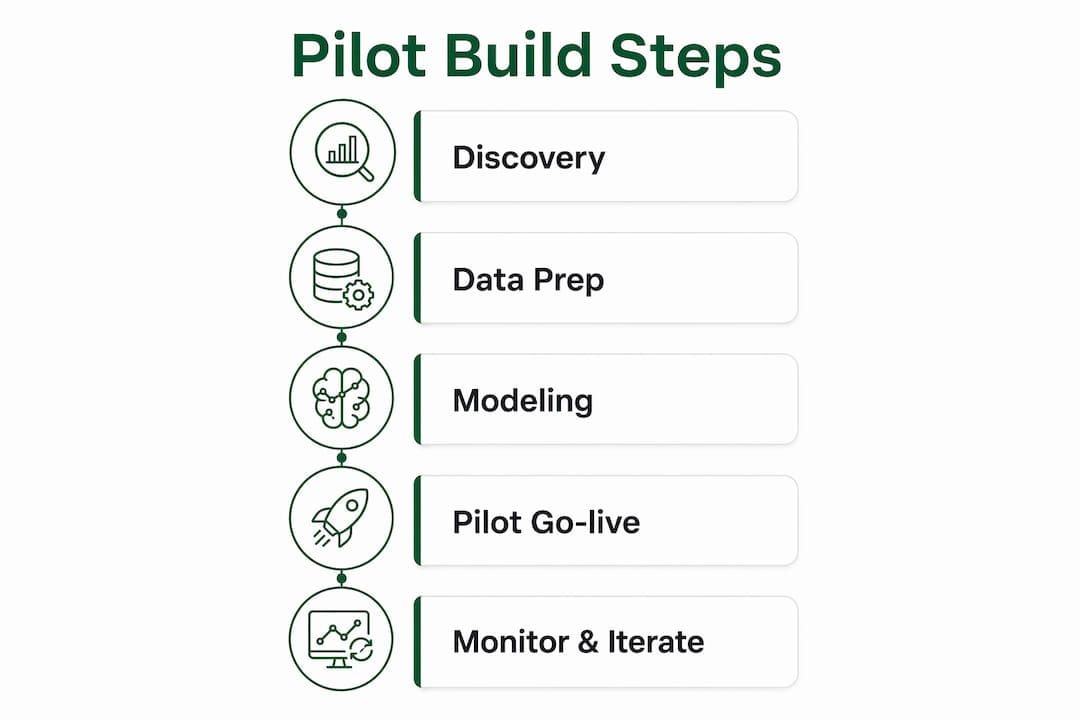
The Neurohain methodology puts process mapping before tool selection, every time. Here is the sprint structure:
Week 0: Discovery. Map the target process end-to-end. Define what “qualified” means in your business. Inventory your data: which 3–5 fields do you have reliably, and which are missing?

Week 1: Data prep. Clean and standardize existing records. Identify enrichment sources for missing fields. Set score decay rules: subtract points after 30 days of inactivity so stale leads don’t inflate your qualified list.
Weeks 2–3: Model and routing. Build an initial rule set or lightweight AI scoring prompt. Map score thresholds to actions. Connect capture points to your scoring layer and route outputs to CRM, calendar, or campaign tools.
Week 4: Pilot go-live. Run live leads through the system with a human-in-loop review gate for high-value records.
Weeks 5–8: Monitor and iterate. Compare predicted conversion against actual outcomes. Adjust weights weekly.
| Signal | Likely source | Notes |
|---|---|---|
| Company size | Form field or enrichment API | Required for firmographic fit score |
| Lead source / channel | CRM or UTM parameter | Weights vary by channel quality |
| Page visits / content downloads | Website analytics | Behavioral intent signal |
| Email open and click rate | Email platform | Engagement score input |
| Demo or form submission | CRM event | Highest-weight conversion signal |
| Inactivity (days since last action) | CRM timestamp | Triggers score decay rule |
Implementation checklist for your vendor or internal team:
- Process map documented and approved by owner
- Minimum 3–5 data fields confirmed and populated
- Score thresholds defined (hot / warm / cold)
- Decay rules configured (30-day inactivity default)
- Routing logic mapped to CRM, calendar, and campaign tools
- TCPA consent confirmed for SMS touchpoints
- Human review gate set for leads above a defined value threshold
- Pilot success metric agreed and logged
How do you measure whether it’s working?
| Metric | Definition | How to measure | Sample SME benchmark |
|---|---|---|---|
| Qualified rate | % of leads meeting MQL or sales-qualified threshold | Leads scored above threshold ÷ total leads | 20% of inbound leads |
| Qualified-to-demo conversion | % of qualified leads that book a demo or appointment | Demos booked ÷ qualified leads | measurable gains within 60–90 days. |
| Average response time to hot leads | Minutes from lead capture to first outreach | CRM timestamp delta | minutes |
| No-show rate | % of booked appointments that don’t show | No-shows ÷ total bookings | 60–80% reduction vs. baseline |
Neurohain pilot data documents no-show reductions of 60–80% on appointment-driven workflows, with consistent results across multiple SME segments.
| Manual triage time saved | Rep hours per week freed from manual review | Rep time log before vs. after | 3–6 hours per rep per week |
Track these weekly during the pilot, then shift to monthly reviews after go-live. Scoring stays predictive only when you regularly analyze which attributes actually correlate with closed deals and adjust weights accordingly. Build that feedback loop into your monthly cadence from day one.
What are the biggest pitfalls and compliance risks?
Score stagnation. A model built on last year’s deals will drift. Schedule a monthly review that compares predicted conversion against actual conversion and reweights or removes signals that no longer correlate.
Missing-data routing errors. A lead with no company size field can land in the wrong bucket. Build a fallback route for incomplete records: send them to enrichment first, not directly to sales.
Over-automation without human review. High-value leads deserve a human gate. Set a score threshold above which a rep reviews before any automated outreach fires.
TCPA and consent. Written opt-in is required before any automated SMS. Document consent at the capture point and store it in your CRM. Custom lead scoring automations can include capping and reset logic to prevent runaway scores, but consent documentation is a legal requirement, not a feature.
Model bias. If your training data skews toward one customer type, the model will undervalue leads that don’t match that profile. Run label audits quarterly.
Pro Tip: Schedule a monthly scoring review. Pull predicted conversion vs. actual conversion for the prior 30 days and adjust at least one weight. Teams that skip this step see model accuracy degrade within 90 days.
How does Neurohain’s pilot methodology work in practice?
Neurohain’s Order First, Then AI approach starts with a documented process map before any tool is selected. In a typical SME pilot covering appointment automation and lead routing, the workflow runs: capture → enrich → score → route → automated confirmation and follow-up.
“Before we touched any automation tool, we mapped every step of how a lead became a booked appointment. That clarity was what made the system work. The AI just made it faster.” — Neurohain pilot client, service business
Neurohain pilot data documents 60–80% reductions in no-shows on appointment-driven workflows, alongside significant time savings on manual follow-up tasks. The same methodology applies whether the pilot uses CoreFlow AI™ for general SME workflows, LeadFlow AI for local service businesses, or VetFlow AI for veterinary clinics.
How do you choose a vendor or decide to build in-house?
Questions to ask any vendor:
- Can you show a completed SME pilot with before/after metrics?
- What is your data security posture and where is lead data stored?
- Which CRMs, calendar tools, and SMS platforms do you integrate with natively?
- What are your SLAs for scoring accuracy and system uptime?
- Who owns the model and the data after the engagement ends?
- What does post-pilot support look like, and what does it cost?
Build vs. buy at a glance:
- Build in-house: lower licensing cost, full data ownership, but requires internal engineering time (typically 6–12 weeks minimum) and ongoing model maintenance.
- Buy or hire a vendor: faster time to a working pilot (4–8 weeks), proven templates, and a defined scope, but you pay for implementation and may pay an ongoing retainer.
For most SMEs without a dedicated data or engineering team, a vendor pilot is the faster path to a working system. The key contract items: agreed success metrics, pilot acceptance criteria, a defined escalation path, and clarity on whether post-pilot support is a one-time fee or a monthly retainer.
What does lead qualification automation actually cost?
Costs break into three buckets. First, tooling: a spreadsheet-plus-no-code-connector pilot (Sheets, Airtable, a GPT prompt, and a routing tool) can run under $200/month in software costs. A mid-tier CRM with native AI scoring, like HubSpot Marketing Hub Enterprise, carries a higher monthly subscription. Second, implementation: a vendor-led pilot typically runs as a one-time project fee covering discovery, build, and go-live, with an optional monthly retainer for ongoing optimization. Third, internal time: even a vendor-led pilot requires 3–5 hours per week from an internal owner during the build phase.
The total cost of ownership for a vendor pilot is almost always lower than a full in-house build when you factor in the engineering hours, model maintenance, and the opportunity cost of a 3–6 month internal timeline versus a 4–8 week vendor sprint.
How do you get your team to actually use the new system?
The automation fails if reps route around it. Three things prevent that. First, involve at least one rep in the pilot from week one. Their input on what “qualified” actually means in practice is more valuable than any model parameter. Second, document the scoring logic in plain language, not a technical spec. Reps need to understand why a lead scored high, not just that it did. Third, assign a single internal owner for the scoring model. Without one person accountable for monthly reviews and weight adjustments, the model drifts and trust erodes.
Training doesn’t need to be a formal program. A 30-minute walkthrough of the routing logic, a one-page SOP, and a shared Slack channel for flagging scoring anomalies covers most SME teams.
What’s coming next in lead qualification automation?
Three trends are already reshaping how SMEs approach qualifying leads online. Agentic AI is the most significant: rather than scoring and routing passively, AI agents can conduct conversational qualification via chat or SMS, asking follow-up questions and updating scores in real time based on responses. This compresses the time from first touch to qualified status from days to minutes.
Second, intent data is becoming more accessible at the SME level. Signals like job postings, funding announcements, and technology adoption patterns, previously available only to enterprise teams, are now surfaced by mid-market enrichment tools.
Third, voice AI is entering the qualification layer. Automated phone qualification calls, handled by AI agents that follow a defined script and update CRM fields in real time, are moving from pilot to production for appointment-heavy businesses.
The underlying principle stays the same regardless of the technology: rule-based approaches remain simpler for early pilots, but AI enables richer multi-signal scoring and automated conversational flows as the system matures.
Key Takeaways
A pilot-first, process-mapped approach to lead qualification automation delivers measurable results within 60–90 days when a clear success metric is set before the first tool is touched.
| Point | Details |
|---|---|
| Start with one process | Pilot appointment scheduling or lead routing first; don’t automate everything at once. |
| Map before you build | Document the process end-to-end before selecting any tool, following an “Order First, Then AI” approach. |
| Set decay rules from day one | Subtract points after 30 days of inactivity to keep your qualified list clean and actionable. |
| Track five core KPIs | Monitor qualified rate, qualified-to-demo conversion, response time, no-show rate, and manual triage time saved. |
| Neurohain pilot program | Neurohain’s CoreFlow AI™, LeadFlow AI, and VetFlow AI pilots deliver working systems in 4–8 weeks with documented no-show reductions of 60–80%. |
What do most guides on lead qualification skip?
The hardest part of lead qualification automation isn’t the scoring model. It’s the moment three weeks after go-live when a rep manually routes a lead because they don’t trust the score. That’s not a technology problem. It’s a documentation and ownership problem.
Every pilot I’ve seen succeed had one person who owned the model, ran the monthly review, and could explain in plain language why a lead scored the way it did. Every pilot that quietly died had a beautifully built system and no one accountable for keeping it honest.
The tactical advice: in the first 90 days, run a biweekly 20-minute review with the rep who uses the queue most. Pull five leads that scored high and didn’t convert, and five that scored low and did. Those eight leads will tell you more about what to fix than any dashboard. Document the adjustments, update the SOP, and repeat. That loop is what turns a pilot into a production system.
Neurohain’s pilot program gets you to a working system fast
Spending months evaluating tools while leads pile up unqualified is a real cost. Neurohain’s CoreFlow AI™ pilot delivers a working lead qualification and appointment automation system in 4–8 weeks, built around your actual process, not a generic template.
The pilot covers process discovery, data prep, scoring model build, CRM and calendar integration, and go-live with a human review gate. Clients in appointment-heavy industries have documented significant reductions in no-show rates and measurable time savings on manual follow-up. For local service businesses, LeadFlow AI applies the same methodology to client acquisition workflows. Prebuilt n8n workflows and AI playbooks cut setup time and reduce custom engineering work.
Ready to see what a pilot looks like for your business? Book a paid discovery session with Neurohain and leave with a documented process map and a scoped pilot plan.
Further reading and useful sources
- AI lead scoring (Demandbase) — Explains dynamic assessment vs. static rules; supports the educational explainer and measurement sections.
- AI-driven lead qualification (monday.com) — Covers expected timelines (60–90 days), rule-based vs. AI tradeoffs; supports the BLUF, roadmap, and future trends sections.
- Lead scoring (CoreMedia) — Iterative scoring and weight adjustment best practices; supports measurement and vendor checklist sections.
- Lead scoring (Centripe) — Score decay controls and inactivity rules; supports the roadmap and risks sections.
- Lead scoring automation (HeyReach) — Simplest viable pilot architecture using Sheets, GPT, and no-code routing; supports the quick wins and roadmap sections.
- Set up lead scoring (Ontraport support) — Advanced controls including decay, capping, and reset logic; supports the risks and implementation checklist sections.
- CoreFlow AI™ (Neurohain) — Order First, Then AI methodology and pilot scope; primary source for the case study and vendor checklist sections.
- How AI reduces veterinary no-shows (Neurohain) — Pilot outcome data (no-show reductions); supports the BLUF and case study sections.
- Templates — n8n Workflows & AI Playbooks (Neurohain) — Prebuilt workflow assets that accelerate pilot delivery; supports the promo and roadmap sections.
Recommended
- LeadFlow AI™ — AI Client Acquisition for Local Business | Neurohain
- How AI Cuts Veterinary No-Shows by Up to 35% | Neurohain
- Templates — n8n Workflows & AI Playbooks | Neurohain