
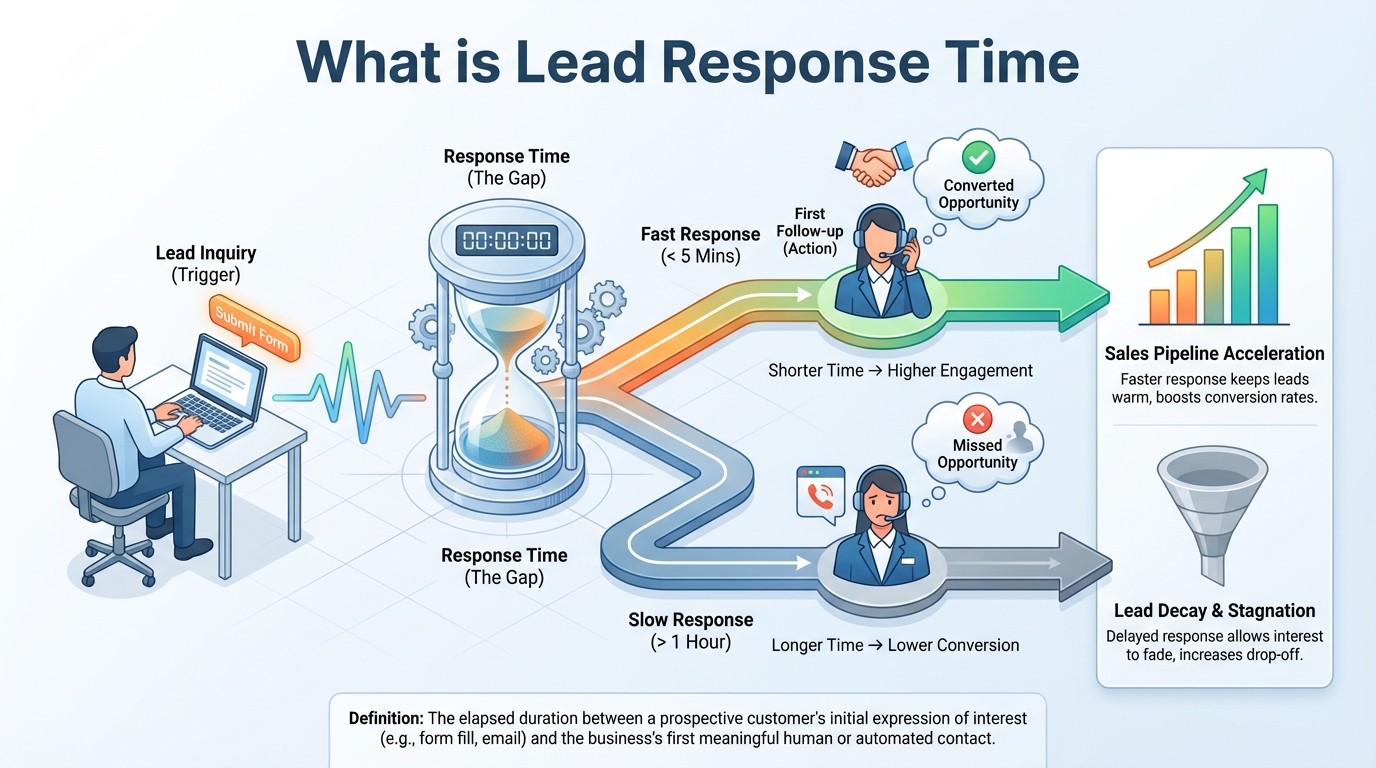
Why Is Your Lead Response Time Costing You High-Ticket Clients? (And How to Fix It)
Estimated reading time: 9 minutes
Key Takeaways
- Speed to lead is economics: Responding to an inquiry within 5 minutes makes your business 21 times more likely to qualify a prospect compared to waiting 30 minutes.
- Inbound lead leakage: Between 39% and 51% of appointment requests occur during off-hours and weekends, where unanswered inquiries silently walk directly to competitors.
- First order, then AI: Buying complex automation tools before mapping clear intake processes only automates operational chaos.
- The Sovereign Human Boundary: Automate administrative triage and instant confirmations, but protect empathetic, clinical, and strategic consultations for human professionals.
Introduction: The Invisible Cost of the Unanswered Inquiry
Most business owners think they need more leads.
They pour thousands of dollars into Google Ads, search engine optimization (SEO), and social media. When revenue stalls, they blame their marketing agency. They assume the market is slow or their ads are broken.
Yet the real problem is rarely lead volume.
High-value clients are already reaching out to your business. The problem is that they vanish into thin air before anyone replies. Inbound interest decays within minutes, not days.
Optimizing your lead response time is the single fastest way to grow your revenue. You do not need to spend another dollar on marketing to unlock this hidden growth.
When a potential client sends a message on Friday evening and hears nothing until Monday, they do not wait patiently. They simply call your competitor.
Unanswered WhatsApp chats, full voicemail boxes, and slow email replies silently drain your bank account. Before you invest in more traffic, you must fix your intake system.
Why does your business keep losing inquiries you paid to attract?
When a qualified prospect contacts you and leaves without booking, your business suffers from inbound lead leakage.
This is not a marketing failure. It is an operational breakdown. You spent money to make the phone ring or make the form ping, but your front desk was too busy to answer.
Consider what happens when people look for a premium doctor, clinic, or private practice:
- Healthcare practices miss between 20% and 35% of their inbound calls during normal work hours (Source: Hicira Missed Call Statistics).
- Up to 85% of callers who hit a voicemail hang up without leaving a message (Source: Hicira Missed Call Statistics).
- Over three-quarters of those callers will never call you back—they immediately contact the next provider on Google.
A high-intent buyer contacts you at their moment of peak urgency. They have a problem they want solved today.
When you reply right away, you build instant trust. When you make them wait, their doubt creeps in. They take their money and look for someone faster.
Where is inbound lead leakage actually happening in your intake?
Most service leaders believe their intake is smooth. In reality, prospective clients run into four major road blocks every single day:
- The Weekend and Evening Black Hole: Between 39% and 51% of appointment inquiries occur after 5:00 PM or during weekends (Source: Ainora Missed Call Statistics 2026). When an inquiry arrives on Friday evening and sits unread until Monday morning, it suffers a 60-plus-hour delay. By Monday, that prospect has already hired someone else.
- High-Friction Mobile Forms: People search on their phones while on the go. If your contact form asks for ten different details, users will give up. Every extra field reduces your completion rate.
- Channel Fragmentation: Your front desk is juggling too many disconnected apps. Web forms land in an email inbox, direct messages sit on Instagram, and chats hide inside WhatsApp. Without a single dashboard, leads slip through the cracks.
- The Lack of Real-Time Booking: Forcing high-intent buyers to play phone tag kills momentum. If a client has to wait for a staff member to manually check open slots, you lose them.
These four friction points ruin your local business lead conversion before your staff even gets a chance to speak with the buyer.
To see how deep the damage goes, we need to look at the hard numbers behind response speed.
How much does a slow lead response time really cost your business?
Speed is not just about polite customer service. Speed is economics.
Your marketing return on investment (ROI) is capped by your response velocity. If you double your ad spend while taking hours to reply, you simply burn cash twice as fast.
Speed signals operational excellence. When a practice answers in two minutes, the client assumes the service itself is world-class. When a practice takes two days, the client assumes the service is careless.
What do the benchmark studies say about speed to lead?
Decades of sales data point to the exact same conclusion: speed wins.
A landmark study published in the Harvard Business Review audited 2,241 companies to see how quickly they handled inbound leads (Source: Harvard Business Review Lead Study). The findings were eye-opening:
- The average response time among businesses that replied was a sluggish 42 hours.
- Nearly 23% of companies never replied to the inquiry at all.
- Businesses that reached prospects within one hour were nearly seven times more likely to qualify the lead than those waiting just two hours.
- Responding within an hour made a company over 60 times more likely to qualify the lead than waiting 24 hours.
Research from MIT and InsideSales proved that minutes matter more than hours (Source: Casey Response Lead Time Statistics). Reaching out within 5 minutes versus 30 minutes makes your team:
- 100 times more likely to connect with the lead.
- 21 times more likely to qualify them for an appointment.
Despite this data, secret-shopper studies show that only 7% of companies respond within 5 minutes (Source: Ainora 5-Minute Lead Response Study 2026). Up to 78% of customers buy from whoever responds first.
Mastering your speed to lead is the single greatest competitive edge you can build this year.
The Cost of Waiting: A Financial Anatomy of 15 Lost Consultations
Let us look at what this looks like for a typical private clinic or high-ticket service provider.
Imagine your business receives 50 qualified inquiries each month. You run ads and maintain a clean website.
Because your team does not work nights or weekends, 15 of those high-intent leads never turn into consultations. They move on to someone else.
Here is what that delay actually costs you:
- Wasted Marketing Spend: If you pay $100 in marketing costs per qualified inquiry, losing 15 leads means throwing $1,500 into the trash every month. That is $18,000 lost each year in ad spend alone.
- Lost Immediate Revenue: If your average initial service or consultation package is worth $2,500, losing 15 clients costs you $37,500 in lost revenue every month. That is $450,000 lost every single year.
- Lost Lifetime Value (LTV): High-ticket clients return and refer their friends. A patient worth $2,500 today is often worth $7,500 over three years. Those 15 lost clients represent over $1.3 million in lost enterprise value over time.
This loss does not stem from a lack of market demand. It is the direct result of slow response systems.
Why does buying more software fail to solve lead conversion friction?
When business owners realize they are losing leads, they often make a classic mistake.
They run out and buy the newest software tool. They sign up for complex CRM platforms, add third-party chatbots, and link apps together using messy webhooks.
This is the premature automation trap.
Buying software before you fix your process only creates more chaos. Here is why out-of-the-box tech often backfires:
- Hallucinating Chatbots: Cheap AI widgets often give incorrect answers, confuse pricing, and frustrate buyers who want clear facts.
- Zapier Spaghetti: Hooking up five different apps without a clear design means things will break. When an API disconnects, leads disappear quietly without anyone noticing.
- Robotic Roadblocks: Forcing a ready-to-buy client through an endless, robotic quiz drives them away.
Software is an amplifier, not a cure. If your basic intake system is messy, adding automation only automates your mess.
You must fix your lead conversion friction at the operational level before you touch new tools.
The Neurohain Philosophy: First Order, Then AI, Then Scale
At Neurohain, we treat intake systems with the same discipline used in banking architecture.
Before you write a single line of automation code, you must create operational order. We follow an iron rule:
First order. Then AI. Then scale.
Automation applied to an efficient system creates incredible speed and scale. But automation applied to a broken system only multiplies confusion.
Creating order means mapping out every single step a prospective client takes:
- You must establish a single source of truth so that no message relies on human memory.
- You must define clear rules for how inquiries are routed, qualified, and answered.
- You must know your exact numbers before you introduce artificial intelligence.
Once this clean foundation is in place, technology stops being an expensive headache. It becomes a reliable engine that captures revenue around the clock.
Which parts of your lead intake workflow should you actually automate?
The goal of lead intake automation is not to replace your staff with robots.
The real goal is simple: remove manual friction so your team can focus on building relationships. When high-ticket buyers reach out, they do not want to wait hours for a basic confirmation.
A well-designed lead intake workflow operates like an air traffic control system. It instantly captures an inquiry, confirms receipt, and routes the details to the right person.
This guarantees a sub-five-minute contact window without forcing your staff to work 24 hours a day.
The Operational Filter: What to Automate vs. What to Keep Human
To protect client trust, you must establish what we call the Sovereign Human Boundary.
This boundary separates simple administrative tasks from genuine human care. Automation should handle logistics and remove friction. Human experts must handle empathy and strategic advice.
Here is what you must automate to remove conversion friction:
- Instant Multi-Channel Acknowledgment: The second a lead arrives via WhatsApp, SMS, or web form, an instant message should confirm receipt on that exact channel.
- Self-Serve Calendar Scheduling: Qualified prospects should receive direct access to open consultation slots immediately.
- Deterministic Triage and Routing: Simple rules should sort inquiries based on service type, location, and urgency, alerting the specific team member on duty.
- Basic Intake Qualification: Lightweight questions can collect essential background details before your team hops on a call.
Here is what must remain strictly human to build trust:
- Clinical and Diagnostic Assessments: Reviewing specific medical histories or bespoke project details.
- Empathetic Consultation: Listening to personal pain points and offering reassurance.
- Custom Treatment and Pricing Proposals: High-ticket clients expect tailored solutions, not rigid algorithmic quotes.
By automating the routine steps, your staff gains the time needed to deliver an exceptional human experience.
Step-by-Step Guide: How to Conduct an Inbound Lead Audit
Most business owners assume their intake is fine because they do not see the clients who walk away.
To fix your leaks, you must examine your business through the eyes of a frustrated buyer. You need an honest, objective audit of your front-end systems.
This self-diagnostic audit will show you where high-intent prospects drop out of your pipeline.
Step 1: Benchmark Mobile Speed and Friction Points
Most high-ticket searches happen on mobile phones during stolen moments of the day.
Turn off your office Wi-Fi, switch to standard cellular data, and visit your website on a smartphone.
Pay close attention to these three core factors:
- Page Load Latency: Does your booking page load in under two seconds, or do large images cause noticeable lag?
- Field Fatigue: Count the total number of form fields. Every question asking for non-essential details reduces your submission rate.
- Tap Accessibility: Are your buttons easy to tap with one thumb, or does a user have to zoom in to click a tiny link?
If your mobile form feels frustrating to fill out, your prospects are leaving before they ever hit submit.
Step 2: Mystery-Shop Response Latencies Across All Channels
To uncover your true response speed, run a Three-Wave Mystery Shop test using personal alias accounts.
Submit test inquiries across your website, WhatsApp, and Google Business Profile at three distinct moments:
- Wave 1 (Peak Hours): Tuesday at 10:15 AM, when your front desk is busy with existing clients.
- Wave 2 (The Evening Window): Thursday at 8:15 PM, when people research services from their couch.
- Wave 3 (The Weekend Blackout): Saturday at 2:00 PM, when offices are typically closed.
Record the exact minutes it takes to receive a meaningful response.
Measure your Time to First Meaningful Touch (TTFMT). A generic «we received your email» autoreply does not count.
Meaningful contact means the prospect has received direct answers, an active calendar link, or a personal message from a human.
Compare your response across channels to calculate your Channel Parity Score. If your main phone line is answered in two rings, but your WhatsApp messages sit unread for two days, your intake system is broken.
Step 3: Quantify Off-Hours Drop-Off and Siloed Inquiries
Once you run your test, look at your historical inquiry records over the last 30 days.
Pull your raw website form logs, phone provider missed-call records, and social messaging inboxes. Compare those numbers directly against your scheduled consultations.
Calculate your Off-Hours Leakage Rate using this simple formula:
Leakage Rate = (Unanswered Leads Arriving After 5:00 PM or Weekends / Total Inbound Volume) × 100
Between 39% and 51% of consumer inquiries happen outside standard business hours (Source: Ainora Missed Call Statistics 2026).
If half your inquiries arrive when your doors are locked, and you have no automated intake active, you are losing half your potential growth.
This single metric reveals the hidden lead conversion friction that is dragging down your revenue.
Frequently Asked Questions
How fast does a business really need to respond to an inbound lead?
You should respond within five minutes or less.
Research shows that reaching out within five minutes makes you 21 times more likely to qualify a prospect compared to waiting 30 minutes (Source: Casey Response Lead Time Statistics).
An hour is the absolute maximum limit. Landmark research confirms that waiting past 60 minutes causes your conversion probability to drop off a cliff (Source: Harvard Business Review Lead Study).
Between 50% and 78% of customers buy from whichever provider replies first (Source: Lead Response Customer Statistics). In local service markets, speed is your greatest sales tool.
Can small service businesses achieve fast response times without 24/7 staff?
Yes, you can easily achieve fast response speeds by using structured lead response management.
You do not need to hire graveyard-shift workers. You only need an automated intake system that handles the first touch.
When an inquiry arrives after hours, your system can instantly send a friendly SMS or WhatsApp message. It can answer basic FAQs and provide a self-serve booking link.
Your prospect books a consultation on the spot, and your staff simply conducts the meeting the next day.
Is a live chatbot necessary to stop lead leakage?
No, live chatbots are often unnecessary and can sometimes hurt your conversions.
Many third-party AI chat widgets look clunky on mobile screens. They often confuse prospects with generic or inaccurate answers.
High-ticket service practices see much better results using simple, friction-free forms paired with instant WhatsApp or SMS triggers.
A clean text message linking directly to your live calendar is faster, friendlier, and far more reliable than a complex chatbot.
Conclusion: Stop Guessing Where Your Inquiries Go
Scaling a high-ticket service business does not require doubling your marketing budget.
You do not need more ad campaigns, complex funnels, or expensive agencies. You simply need to capture the high-intent buyers who are already knocking on your door.
Improving your lead response time turns wasted marketing spend into secured consultations.
When you eliminate intake friction, you protect your staff from burnout, outperform slower competitors, and build instant trust with every client.
Stop Guessing Where Your Inquiries Go: Neurohain’s Free Digital Presence Audit
Most business leaders are too busy managing day-to-day operations to spot operational leaks in their intake systems.
If you are not sure how many leads slip through your fingers each weekend, Neurohain is here to help.
We provide a comprehensive, engineer-led Free Digital Presence Audit tailored for private practices, clinics, and premium service providers.
Here is what you will receive:
- A Complete Diagnostic Report: Delivered to your inbox within five business days.
- Response Velocity Benchmarking: An objective assessment of your website speed, booking pathways, and multi-channel routing.
- A Clear Operational Roadmap: Precise guidance showing exactly which bottlenecks to fix first—and which tools you should avoid.
Do not let slow systems drain your revenue for another month. Request your free diagnostic audit today and fix your intake leaks before you spend another dollar on marketing.
Ready to Eliminate Inbound Lead Leakage?
Book a strategy session with our engineering team to audit your intake systems and capture high-intent clients automatically.