
Proposal automation turns your proposal process from a slow, error-prone document task into an auditable, AI-augmented revenue workflow. The payoff is not prettier PDFs. It is faster turnaround, pricing governance that stops unapproved discounts before they reach clients, and live engagement signals that tell you exactly when to follow up. Neurohain’s CoreFlow AI is built around this exact model.
What an SME should expect within 30–90 days of adoption:
- Draft turnaround drops from days to hours once a governed content library is in place
- Pricing exceptions require documented approval before any proposal leaves the building
- Approval cycle time becomes measurable and improvable
- Engagement data shows which proposal sections prospects skip, so follow-up gets sharper
Table of Contents
- What is proposal automation, and how does it differ from a builder?
- Why SMEs should invest in proposal management, not just prettier docs
- What core features should your proposal software actually include?
- How do you evaluate and choose the right solution?
- A practical implementation roadmap with KPIs to track
- What results does Neurohain’s methodology actually produce?
- Key Takeaways
- The part most SMEs get wrong about proposal software
- Neurohain’s CoreFlow AI takes proposals from draft to signed faster
- Useful sources and further reading
What is proposal automation, and how does it differ from a builder?
Proposal automation covers the full lifecycle: intake, content sourcing, approval routing, pricing governance, delivery, engagement analytics, and CRM sync. A proposal builder handles document formatting and e-signature. That distinction matters when you are spending money.
A builder is the right tool if your only problem is blank-page friction. A proposal management system is the right tool if proposals are leaking revenue through inconsistent pricing, slow approvals, or zero visibility into what happens after you hit send.
The clearest diagnostic: ask yourself whether your current process has an automated pricing approval path. If the answer is no, you need management software, not a better template. Proposal management software handles the full lifecycle, including approval workflows and pricing governance, while builders stop at formatting and e-signature.
Neurohain and CoreFlow AI sit firmly on the management side. They are AI workflow vendors focused on lifecycle automation, not document design.
Pro Tip: Before any vendor demo, map your current proposal steps on a whiteboard. If you cannot draw a clear line from intake to signed approval with named owners at each stage, that gap is where your revenue is leaking.
Why SMEs should invest in proposal management, not just prettier docs
The ROI from automated proposals comes from governance, speed, and data-driven follow-up, not from templates alone. Most organizations lose value by treating proposal creation as a formatting chore instead of a connected workflow.
Key business benefits:
- Fewer errors: Centralized content libraries prevent outdated pricing or stale case studies from reaching clients
- Pricing control: Automated approval routing for defined pricing tiers prevents unapproved or unprofitable discounts from reaching customers
- Faster approvals: Defined routing replaces email chains with trackable, time-stamped decisions
- Higher win rates: Live engagement analytics identify which sections prospects read most, letting sales teams address objections before the prospect decides
- Scalable knowledge: Approved content gets reused across the team, not rebuilt from scratch each time
Vendor-cited data points to close-rate improvements when interactive pricing tables, templates, e-signatures, and embedded analytics are combined. One vendor’s product page claims an close-rate lift from these features, though that figure comes from marketing materials and should be treated as directional rather than guaranteed.
The common mistake is treating proposals as a formatting task. The real risk is a rep sending a proposal with a discount that was never approved, or following up blind because no one knows whether the prospect even opened the document. For US businesses handling sensitive client data, SOC 2 compliance and data residency controls are worth confirming with any vendor before signing.
What core features should your proposal software actually include?
Prioritize features that prevent revenue leakage first. Design modules are a distant second.
Must-have capabilities (in priority order):
- Pricing governance with tiered approvals — non-negotiable; this is where margin protection lives
- Approval workflows with audit trails — required for compliance and accountability
- Centralized content library with permission controls — governed content libraries let teams lock down approved language while allowing reps to personalize safe sections
- Live engagement analytics — know when a prospect opens the proposal and which sections they read
- CRM sync (Salesforce, HubSpot) — opportunity data autofills proposals and engagement feeds back into CRM records automatically
- E-signature — table stakes; confirm it works on mobile
- Template and variable support — speeds drafts without sacrificing accuracy
- AI-assisted first drafts — modern platforms can generate personalized first drafts grounded in verified content from a governed knowledge base
Demo scenarios to validate before you buy:
- Ask the vendor to run a live RFP from intake to signed proposal in real time
- Request a walkthrough of the pricing approval workflow with a tiered discount scenario
- Ask where content provenance is tracked (can you see which version of a clause was used?)
- Confirm CRM sync works bidirectionally, not just on send
- Pull up an engagement analytics report from a real sent proposal
If a vendor cannot demo any of these live, that is a red flag, not a scheduling issue.

How do you evaluate and choose the right solution?
Choose solutions that automate governance and connect to live data, then validate that claim in the demo.
Questions to ask every vendor:
- Show me a complete RFP intake to signed proposal in your system
- Walk me through what happens when a rep submits a proposal with a discount above the approved threshold
- Where is content version history stored, and who can change approved language?
- How does your CRM sync handle a deal that moves stages mid-proposal?
- Show me engagement analytics on a real proposal sent in the last 30 days
Red flags (stop the evaluation if you see these):
- Cannot demonstrate approval routing live
- No audit trail for content changes or pricing decisions
- Content is stored per-user rather than in a centralized, governed library
- Integration options are limited to Zapier webhooks with no native CRM connectors
- No answer on data residency or security certifications for US-based data
Pilot plan (30–90 days):
- Days 1–14: Process mapping and content audit; identify the three proposal types with the highest volume
- Days 15–30: Build pilot workflows for those three types; load approved content into the library
- Days 31–60: Run live proposals through the system; track draft time, approval cycle time, and pricing exceptions
- Days 61–90: Measure results, expand to remaining proposal types, and train the full team
Pricing for proposal management software typically involves a setup fee covering integration and content migration, plus a recurring per-seat or per-proposal fee. The largest cost drivers are CRM integration complexity, content migration volume, and AI usage. Expect the clearest ROI signals around draft time reduction and pricing exception rate within the first 60 days.
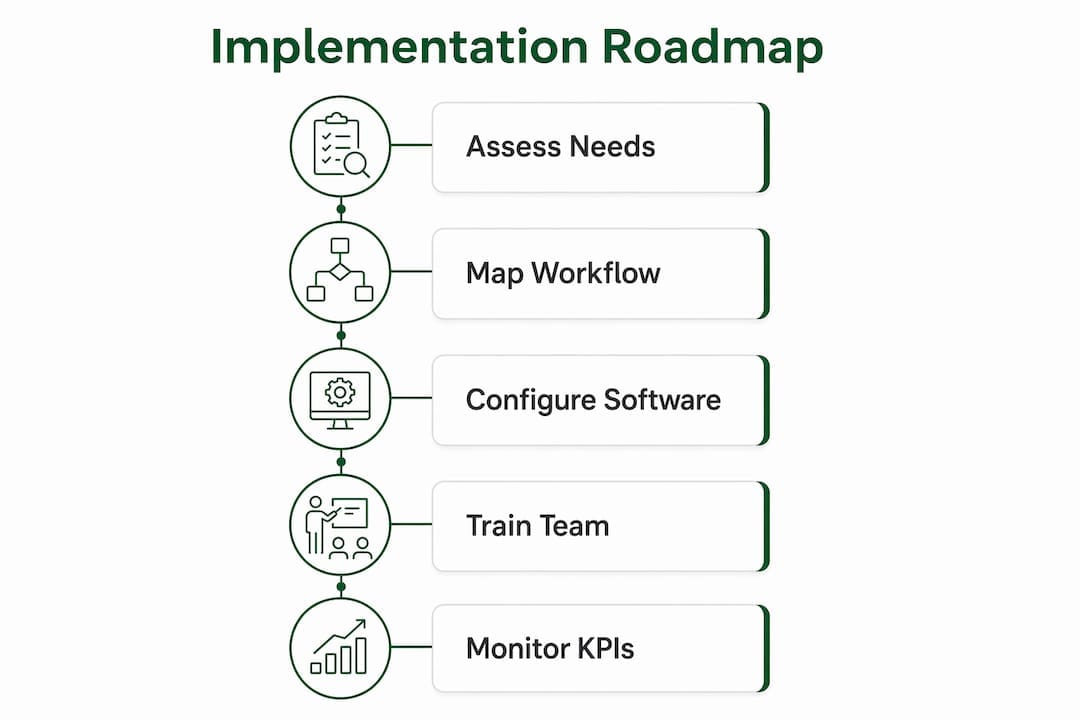
A practical implementation roadmap with KPIs to track
The short version: pilot, expand, govern, optimize. Here is what that looks like in practice.
Implementation phases:
- Discovery and process mapping — follow Neurohain’s Order First, Then AI principle: map every current proposal step before touching a tool
- Content library cleanup — audit existing templates, retire outdated versions, assign ownership for each content block
- Build pilot workflows — configure intake forms, approval routing, and pricing tiers for the highest-volume proposal type
- Train the team — focus on content owners (who can edit what) and approvers (what triggers their queue)
- Run the pilot — send real proposals through the system for 30 days
- Measure and expand — use KPI data to justify rollout to remaining proposal types
KPIs to track:
| KPI | Target Range | Why It Matters |
|---|---|---|
| Draft turnaround time | Fast for standard proposals | Measures content library and AI draft quality |
| Approval cycle time | Fast | Signals whether routing rules are clear |
| Pricing exception rate | Low | Indicates governance is working |
| Proposal-to-close rate | Improved over baseline | Ties automation to revenue outcomes |
| Client engagement score | Track section-level open rates | Identifies objections before follow-up |
Ownership matters as much as tooling. Assign one person to own the content library, one to own pricing rules, and one to own approval routing. Without named owners, governance erodes within 90 days.
Common rollout snags: missing CRM field mappings that delay autofill, content owners who are too busy to audit the library before go-live, and approval routing that is too granular to be practical. Plan for all three.
What results does Neurohain’s methodology actually produce?
Neurohain’s approach produces measurable operational lifts because it starts with process clarity, not tool selection. The methodology is called Order First, Then AI: map and order processes before applying automation, so the tools solve real bottlenecks rather than digitizing broken workflows.
Neurohain-reported deployments in veterinary clinics have produced a 60–80% reduction in no-shows and measurable time savings on repetitive follow-ups. Full case study detail is available directly from Neurohain.
The methodology in practice:
- Process diagnosis before any tool is selected or configured
- Content and data audit to identify what is ready for automation and what needs cleanup first
- Workflow build with named owners for each governance layer
- Pilot with defined KPIs, not open-ended testing
- Structured handoff so the SME team can operate the system independently
The variance in results across deployments comes down to three factors: how mature the existing content is, how complex the CRM integration is, and how quickly the internal team can commit to the pilot. SMEs with cleaner content and a single CRM see faster results. To secure internal budget, present the pricing exception rate and draft turnaround time as the two leading indicators leadership will care about most.
Key Takeaways
Proposal automation delivers its highest ROI when it is treated as a revenue workflow, not a document-formatting upgrade.
| Point | Details |
|---|---|
| Lifecycle over design | Require approval workflows, pricing governance, and analytics before evaluating design features. |
| Governance prevents margin loss | Automated pricing approval routing stops unapproved discounts before they reach clients. |
| Pilot in 30–60 days | Map three high-volume proposal types, build workflows, and measure draft time and pricing exceptions. |
| Engagement data drives follow-up | Live analytics showing which sections prospects read most sharpen follow-up and surface objections early. |
| Neurohain’s approach | CoreFlow AI, VetFlow AI, and LeadFlow AI apply the Order First, Then AI methodology to SME proposal and workflow automation. |
The part most SMEs get wrong about proposal software
The conversation around proposal automation almost always starts with the wrong question. SMEs ask “which tool has the best templates?” when they should be asking “where does our proposal process leak revenue?”
Templates are the last 10% of the problem. The first 90% is governance: who approves what, at what price threshold, with what content, and how does the outcome feed back into the CRM. A beautiful proposal with an unapproved discount and no follow-up system is worse than a plain one with a clear approval trail, because at least the plain one does not create a margin problem.
The other thing most guides skip: change management is the real implementation risk, not the technology. The tool is usually ready in 30 days. Getting the team to actually use the content library instead of their personal folders takes 60–90 days of consistent reinforcement. Plan for that, not just the technical rollout.
Neurohain’s CoreFlow AI takes proposals from draft to signed faster
Neurohain builds custom AI-powered proposal workflows for SMEs that cover the full lifecycle: process diagnosis, content library setup, approval routing, CRM integration, and team training. The primary outcome is a proposal process that runs without the owner as the bottleneck.
CoreFlow AI is Neurohain’s productized solution for SME proposal and document automation. A typical pilot runs 30–60 days and includes process mapping, workflow build, integration with your existing CRM, and a trained team that can operate the system independently. For service businesses, LeadFlow AI and VetFlow AI extend the same methodology to lead management and appointment automation.
The engagement model is straightforward: a project-based setup fee covers diagnosis, build, and integration; an optional ongoing retainer covers optimization and content governance. Most SMEs see measurable draft time reduction and pricing exception control within the first pilot month.
Pro Tip: Start with your three highest-volume proposal types. A focused pilot on real proposals produces better data than a broad rollout on hypothetical ones.
Request a process-mapping call at neurohain.com to see whether CoreFlow AI fits your current workflow.
Useful sources and further reading
- Proposal lifecycle vs. builder distinction: Responsive — Proposal Management Software — supports the definition section and core features checklist
- Proposal automation definition and bid automation mechanics: Upland Software — What is Proposal Automation? — supports the definition and content population features
- Pricing governance and approval routing: Klyck — Proposal Approval Workflow — supports the governance and red flags sections
- Live engagement analytics: Proposify — Proposal Software — supports the analytics feature requirement and follow-up strategy
- Close-rate lift claims: PandaDoc — Sales Proposal Software — vendor marketing claim cited directionally in the why-it-matters section
- RFP workflow phases and timelines: Workforce Playbook — Play 4 Workflow Diagram — supports the implementation roadmap phases
- Neurohain methodology and reported outcomes: Neurohain — Order First, Then AI — supports the implementation roadmap and case evidence sections
- 5 processes to automate now: Neurohain — Guide: 5 Processes You Can Automate Today — practical starter resource for SMEs beginning a pilot
For case studies or to see a live pilot walkthrough, contact Neurohain directly at neurohain.com.