
The Architecture of Speed to Lead: Why After-Hours Inquiries Are Costing You Thousands (And How AI Solves It)
Estimated Reading Time: 8 minutes
Key Takeaways
- Over 50% of inbound high-intent inquiries arrive outside standard business hours, when buying intent is highest.
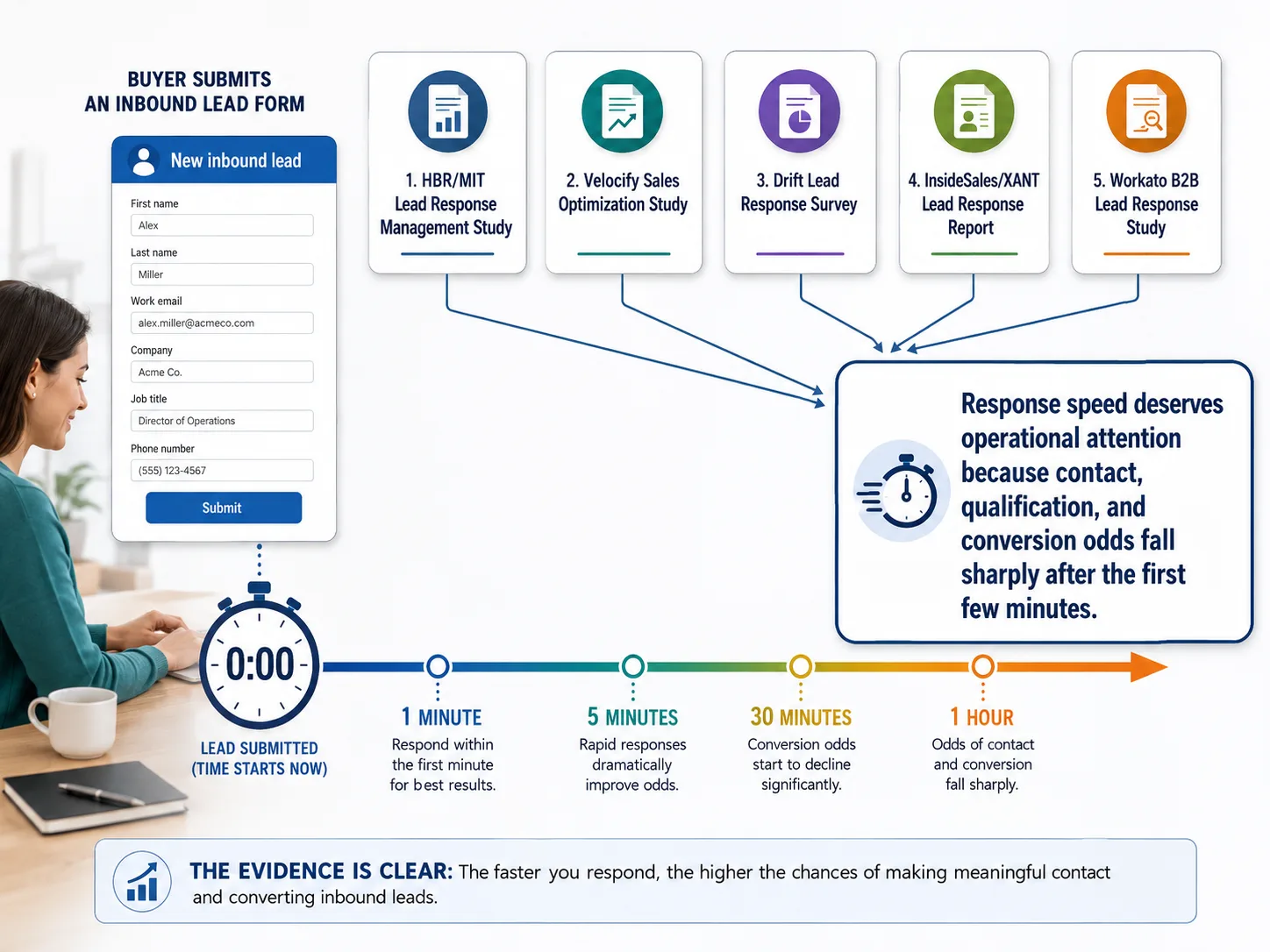
- Contacting a prospect within 5 minutes makes you 21 times more likely to qualify them compared to waiting 30 minutes.
- Static auto-responders fail because they delay action; automated conversational triage immediately qualifies leads and books appointments.
- Full CRM replacements fail up to 70% of the time; modular API integration protects your stack and drives instant ROI.
- Neurohain’s LeadFlow AI provides 24/7 sub-60-second response times across messaging channels and voice while escalating high-value cases to your team.
Table of Contents
- The Operational Blind Spot Bleeding Service Businesses
- The Cold Math of Speed to Lead: Why Minutes Determine Margin
- The Qualification Bottleneck: Why Auto-Responders Fail
- Neurohain’s Core Operational Principle: «Order First. Then AI. Then Scale.»
- Modular API Architecture vs. The SaaS Migration Trap
- Guardrails and the 80/20 Rule: Engineering Seamless Human Handoff
- Solution in Practice: Introducing LeadFlow AI™
- Fixing Inbound Leakage for Good
- Frequently Asked Questions
You spend thousands of dollars every month on Google Ads, search rankings, and referrals. Prospects land on your site, read your reviews, and fill out your contact form.
Then, everything goes quiet.
The biggest leak in your sales pipeline happens in the first five minutes after someone reaches out. This is where high-ticket deals slip away unnoticed.
For clinics, boutique law firms, and premium contractors, speed to lead is no longer just a customer service goal. It is an operational bottleneck that decides whether your business grows or bleeds revenue.
THE INBOUND FUNNEL LEAK:
[ Ad Spend & Traffic ] ──► [ Web Form Submitted ] ──► [ The 5-Minute Black Hole ] ──► 78% Lost to Competitors
The Operational Blind Spot Bleeding Service Businesses
Most service businesses run on a standard 9-to-5 schedule. The problem is that your prospective clients do not.
Industry data shows that 50% to 52% of all inbound inquiries arrive outside of regular business hours. They come in during evenings, late nights, and across weekends.
These after-hours prospects are not casual browsers. Leads submitted between 8:00 PM and 10:00 PM actually show 15% higher buying intent than daytime inquiries. People research high-ticket medical care, legal help, or home renovations when they are relaxed at home—not while multitasking at work.
Yet, most companies leave these inquiries sitting in a dark inbox until the next morning.
The average professional service business takes 42 hours to respond to a new inquiry. Worse, roughly 23% of businesses never respond at all.
Leaving prospects waiting creates massive internal strain:
- Practice managers waste 8 to 12 hours every week manually sorting spam, price shoppers, and urgent requests.
- Knowledge workers feel trapped in an «always-on» cycle: 76% check their work email outside office hours, and 40% open their inbox before 6:00 AM.
- Intake staff face morning backlogs, leading to rushed calls and inconsistent notes.
Relying on manual triage turns your best employees into administrative bottlenecks.
A generic message saying «Thank you, we have received your request and will reply within 24 hours» does not solve this. To high-intent buyers, that note signals a dead end.
Fixing this problem requires true after-hours lead conversion powered by automated systems.
The Cold Math of Speed to Lead: Why Minutes Determine Margin
When a prospect needs a high-value service, they do not wait patiently. They open three or four browser tabs, submit inquiries to several providers, and wait to see who answers first.
The business that responds first with a structured, intelligent answer almost always wins the contract.
In fact, 78% of customers buy from the provider that responds first.
Research from MIT and InsideSales shows just how steep the drop-off is when your response slows down:
- Contacting a web lead within 5 minutes versus 30 minutes makes you 21 times more likely to qualify that lead.
- Calling within 5 minutes makes reaching the prospect 100 times more likely compared to waiting 30 minutes.
- Reaching out within the first 60 seconds delivers a 391% lift in conversion rates.
Lead Qualification Likelihood by Response Time:
Within 5 Minutes:  [█████████████████████] 21x
Within 30 Minutes: [█] Baseline
After an hour, your chances crater. Reaching out within the first hour makes you nearly 7 times more likely to have a meaningful conversation than waiting 60 minutes. After 24 hours, the lead has essentially gone cold.
Buyers today expect lightning-fast answers. Research shows that 82% of consumers say an immediate reply is critical when they have a sales question, with 60% defining «immediate» as 10 minutes or less.
When you tell an evening prospect to wait until 9:00 AM tomorrow, you hand your revenue straight to a faster competitor.
The Qualification Bottleneck: Why Auto-Responders Fail
Many businesses try to solve slow lead response time with email auto-responders.
This creates an illusion of speed. A canned email tells the client: «We got your note, now go wait.»
It does not answer their questions. It does not check if they are a good fit. Most importantly, it does not move them closer to booking an appointment.
High-value conversion requires active inbound lead qualification, not passive form collection. When an inquiry lands, your intake system must immediately evaluate four key pillars:
- Intent: What exact procedure, legal service, or project do they need?
- Specific Requirements: Do their needs match your specialty and service area?
- Urgency: Do they need help today, this week, or next quarter?
- Budget and Readiness: Are they ready to pay your rates and move forward?
If a prospect qualifies, they should be able to book an appointment on the spot. Letting qualified buyers pick an open time slot directly from your calendar roughly doubles booking rates, taking form-to-meeting conversions from 30% up to 67%.
PASSIVE FORM vs. CONVERSATIONAL TRIAGE:

Static Form:
[Lead Submits Form] ──► [Auto-Reply: "Wait 24h"] ──► [Lead Leaves / Calls Competitor]

Conversational Triage:
[Lead Submits Form] ──► [Instant Smart Questions] ──► [Lead Qualified] ──► [Booked on Calendar]
Channel choice also plays a massive role in whether your messages get seen.
Traditional email workflows are losing their edge. Typical business emails see open rates around 20%, and replies often take days. Many messages end up buried in spam folders.
By contrast, WhatsApp Business automation delivers open rates of 98%, with up to 90% of messages opened within three minutes. Meeting prospects on messaging channels creates direct, two-way engagement that email simply cannot match.
Neurohain’s Core Operational Principle: «Order First. Then AI. Then Scale.»
Many companies rush to add artificial intelligence by pasting an open-ended chatbot onto their website.
This usually backfires. Raw language models without strict rules make mistakes. They can misquote prices, promise services you do not offer, or give inaccurate advice.
Automating a broken process does not fix it. It just creates broken results faster.
At Neurohain, our rule is simple: Order first. Then AI. Then scale.
Before writing any software code, you must design a clear intake decision tree. We map your intake rules using strict logical flows:
Deterministic Intake Architecture:
[Inbound Ping]
       │
       ▼
[Intent Check] ────────── Spam / Irrelevant ──────────► [Polite Archive]
       │
       ▼ (Valid Inquiry)
[Location / Scope Check] ── Outside Service Area ─────► [Helpful Referral]
       │
       ▼ (Eligible)
[Urgency Check] ───────── Emergency / Urgent ────────► [Instant Alert to On-Call Staff]
       │
       ▼ (Standard Qualified)
[Direct Calendar Booking] ──► [Real-Time CRM Sync]
To make conversational AI triage safe and reliable, the system must follow four gating questions:
- Problem Scope: What exact issue do you need resolved?
- Service Area: Are you located within our physical or legal operating zone?
- Timeline: How soon do you need to begin?
- Decision Stage: Are you ready to proceed if the terms are a match?
The AI handles natural language so the conversation feels smooth and human. But the underlying business logic remains rigid and controlled.
The software cannot hallucinate terms, alter fee structures, or book unavailable calendar slots. It operates within fixed guardrails to protect your brand reputation. Once this logic is locked in, the next question is how to connect it to your current software tools without breaking your existing operations.
Modular API Architecture vs. The SaaS Migration Trap
When business owners realize they are losing leads, software vendors offer an easy answer: buy their all-in-one platform.
They tell you to throw away your current tools. They ask you to move your entire practice to their new, shiny system.
This is usually a trap. Ripping out your core software creates chaos, slows down your staff, and costs a fortune.
Industry research shows that 50% to 70% of CRM migrations fail to achieve their defined business goals.
These projects do not fail because the software lacks features. Forrester found that 70% of CRM failures happen because of low user adoption, staff resistance, and broken internal processes.
THE MIGRATION TRAP vs. MODULAR PLUMBING:

The Migration Trap:
[Existing Tools] ──► [Painful Migration] ──► [Staff Resistance & Errors] ──► High Churn

Modular Plumbing:
[Existing Tools] ──► [API Middleware + AI] ──► [Clean Lead Data & Bookings] ──► Immediate ROI
Your team already knows how to use their current tools. Whether you run on HubSpot, Clio, Dentrix, or a custom calendar, you should not have to replace them.
The pragmatic answer is modular plumbing. Instead of replacing your stack, you build an intelligent layer right on top of it. Modern APIs and webhooks allow conversational AI triage to connect directly to your daily tools:
- It captures conversations from web forms, SMS, and messaging apps.
- It checks real-time doctor, attorney, or consultant availability via Google Calendar or Cal.com.
- It logs clean notes, tags, and contact details straight into your existing database.
Your front-desk team does not need to learn a complicated new program. They wake up each morning to find pre-screened, high-intent meetings already booked on their schedule. The plumbing works behind the scenes, leaving your daily routine completely undisturbed.
Guardrails and the 80/20 Rule: Engineering Seamless Human Handoff
True automation is not about removing humans from your business. It is about protecting your team’s focus so they can do their best work.
Every service business operates on the 80/20 rule:
INBOUND INQUIRY DISTRIBUTION:
┌───────────────────────────────────────────────────────────┬──────────────┐
│                  Routine Queries (80%)                    │ Priority 20% │
│  Hours, basic pricing, insurance, directions, scheduling  │ Complex deals│
└───────────────────────────────────────────────────────────┴──────────────┘
               ▲                                                   ▲
       Handled by AI Instantly                            Escalated to Staff
Roughly 80% of inbound questions are simple and repetitive. People want to know your opening hours, accepted payment plans, service areas, or available appointment slots.
Your staff should not spend half their day typing out these same answers. An automated engine can resolve these simple requests in seconds, 24 hours a day.
The remaining 20% of inquiries represent your most valuable opportunities. These are high-ticket commercial projects, complex surgical cases, or sensitive legal issues. These cases require human judgment, empathy, and personal sales skills. When an inquiry hits this threshold, the system must trigger an instant handoff.
A great system never leaves your staff in the dark. It delivers a rich context file directly to your on-call team through SMS or instant push notifications:
[HOT ESCALATION - PRIORITY LEAD]
Name: Sarah M.
Phone: +1 (555) 019-2831
Intent: Full-arch dental implants (Immediate surgery desired)
Timeline: Within 14 days
Financing Status: Pre-qualified / Private pay
Status: WhatsApp thread warm. Tap here to pick up conversation or call immediately.
Your staff member will never have to ask the prospect to repeat themselves. They pick up the phone with the exact context in hand. This makes the buyer feel heard, valued, and ready to buy.
Solution in Practice: Introducing LeadFlow AI™
Fixing pipeline leakage requires moving from theory to an engineered system.
Neurohain built LeadFlow AI™ to give high-ticket service companies a reliable, automated sales front-end. It stops deal leakage without forcing you to change your existing software.
THE LEADFLOW AI™ 5-PILLAR ARCHITECTURE:

[ Inbound Multi-Channel Traffic ]
               │
               ▼
┌──────────────────────────────────────────────────────────────────────────┐
│                             LEADFLOW AI™                                 │
│                                                                          │
│  1. Speed to Lead Engine        ──► Sub-60-sec qualification & chat     │
│  2. AI Voice Layer              ──► Inbound call & after-hours capture   │
│  3. Omnichannel Web Widget      ──► Direct website-to-messaging pipeline │
│  4. Database Reactivation       ──► Conversational outreach to old leads │
│  5. Reputation & Review Engine  ──► Automated client review generation   │
└──────────────────────────────────────────────────────────────────────────┘
               │
               ▼
[ Clean Appointments Placed Directly Into Your Existing Calendar & CRM ]
The system uses five connected components to capture and convert high-intent buyers:
1. Speed to Lead Engine
This core engine delivers instant two-way qualification across web chat, SMS, and WhatsApp Business automation. It engages new prospects in under 60 seconds, answering questions and vetting their needs.
2. AI Voice Layer
Missed phone calls are a silent revenue killer. This conversational voice system answers calls after hours, collects key intake details, and sends booking links via text message before the caller can try a competitor.
3. Omnichannel Web Widget
Static contact forms create waiting lines. This smart widget bridges the gap, guiding website visitors straight into fast two-way conversations on their preferred messaging apps.
4. Database Reactivation Engine
Generating brand-new leads is expensive. Reactivating old, dormant leads costs 5 to 7 times less than running cold ad campaigns. This engine reaches out to past contacts with helpful check-ins, filling open calendar slots with zero extra ad spend.
5. Reputation & Review Engine
Social proof drives incoming leads. Once a client completes a service, the system sends a simple review request, helping your business consistently collect five-star ratings on Google.
The Unit Economics of Lead Leakage
The financial impact of faster response times is immediate. Consider the monthly numbers for a typical high-ticket clinic, boutique firm, or specialty contractor:
| Operational Metric | Manual / Legacy Intake | LeadFlow AI™ Automated Pipeline |
|---|---|---|
| Inbound Leads (Monthly) | 100 leads | 100 leads |
| After-Hours Inquiries (~50%) | 50 leads (Avg. response: 14 hrs) | 50 leads (Avg. response: < 60 sec) |
| Qualification Rate (MIT/HBR) | 10% (5 leads qualified) | 35% (17 leads qualified) |
| Average Client Value (LTV) | €3,500 | €3,500 |
| Closed Deals from After-Hours | ~1 to 2 clients (€5,250) | ~5 to 6 clients (€19,250) |
| Monthly Revenue Delta | Baseline | +€14,000 / month (€168,000 / yr) |
A modular rollout takes just four weeks. It requires no complicated staff training and leaves your current software stack completely intact.
Fixing Inbound Leakage for Good
The math behind client acquisition is straightforward. You do not always need to spend more money on ads to grow your business.
Often, the fastest way to add revenue is to stop letting your current inquiries slip away.
In high-value services, speed to lead is the single highest-ROI lever you can pull. When you answer interested prospects within seconds, you win the deal before your competitors even open their inbox.
By using automated triage and smart guardrails, you can capture demand around the clock while giving your front-desk staff their time back.
Stop letting valuable evening and weekend leads slip away:
- Option 1: Book an Operational Architecture Consultation to map your business intake logic.
- Option 2: Request Neurohain’s Free 5-Day Digital Funnel Audit to uncover your exact after-hours response delays and pipeline leaks.
Frequently Asked Questions
Will conversational AI triage sound robotic to high-value clients?
No. Modern systems use advanced language models to keep conversations polite, natural, and helpful. The AI does not try to fool prospects into thinking it is a human. Instead, it acts as a capable digital assistant that answers questions and schedules appointments without delay.
How does this connect to our CRM without causing errors?
We do not replace your software. We use secure APIs to link the intake assistant directly to your current CRM and calendar. The system only writes clean, structured data after a prospect answers your gating questions, keeping your database organized and accurate.
What happens if a prospect asks a complicated question?
If a question falls outside the system’s approved knowledge base, the conversation pauses. The system notifies your team with an alert, a full chat summary, and the prospect’s contact details so a team member can take over.
How quickly can a business see results from faster response times?
You will see results as soon as the system goes live. Because evening and weekend inquiries receive answers within 60 seconds, businesses typically notice an increase in booked consultations within the first 14 days.
Why use WhatsApp Business automation instead of email?
Email open rates hover around 20%, and replies often take days. By contrast, WhatsApp messages see 98% open rates, with most read within three minutes. Reaching prospects where they already spend time makes scheduling appointments much faster.
Stop Losing Qualified Deals to Response Delays
Let our team show you how automated speed to lead can plug your after-hours funnel leaks.